
08-22-2025 - StelOptica Intelligence Insights
While Washington focuses on China's Indo-Pacific naval ambitions, Beijing is quietly executing a more immediate threat to U.S. security: the systematic acquisition of critical port infrastructure across Latin America and the Caribbean (LAC). This isn't merely about commercial competition – it also serves to create a vertically integrated system capable of monitoring, controlling, and potentially weaponizing the very supply chains that connect the Americas.
Our analysis reveals how China's port acquisitions, when combined with security equipment penetration, demonstrated dual-use capabilities, and developments in container-based munitions, create unprecedented vulnerabilities at America's doorstep.
Chinese port acquisitions concentrate at strategic chokepoints across Latin America, creating a surveillance and control architecture that spans from South America to the U.S. border. This is more than random commercial expansion, China is systematically positioning itself at every critical LAC maritime transit point.
The architecture begins at the hemisphere's most vital chokepoint. In Panama, Chinese companies managed and operated the ports of Balboa and Cristobal, until very recently – strategically positioned on the Pacific and Atlantic sides of the Panama Canal, respectively. This straddling control granted Beijing unprecedented visibility over one of the world's most vital maritime transit points, where 6% of global trade passes through annually. Every vessel transiting the canal must pass by Chinese-operated terminals at either end.
In the Caribbean, China's acquisition of Kingston's port in Jamaica—the ninth-largest in Latin America by throughput—supplements existing Chinese SIGINT facilities in Cuba to create comprehensive surveillance coverage of the Caribbean basin. This monitors both naval movements and commercial shipping through critical routes between the canal and U.S. ports.
This is more than a theoretical capability. The same dual-use infrastructure that enables commercial operations provides perfect cover for intelligence collection. Every container scanned, every vessel tracked, every shipping manifest processed becomes potential intelligence data flowing back to Beijing.
The net tightens along Mexico's Pacific coast, where Chinese operations create the final linkages to U.S. borders. China operates Lázaro Cárdenas—Mexico's largest port by total cargo volume—through specialized container terminals that handle, store, and control container movements by both land and sea.
At Manzanillo, another crucial hub for U.S.-bound trade, Chinese management introduces surveillance vulnerabilities into North American supply chains. More concerning, the port's documented role in fentanyl trafficking illustrates how Beijing's infrastructure strategy intersects with transnational criminal networks – whether by design or neglect. If millions of doses of fentanyl can flow through Chinese-controlled terminals, what else can pass undetected?
Together, these Mexican ports create a critical vulnerability in North American supply chains. Chinese firms now control the primary Pacific gateways through which Asian goods flow to U.S. markets, positioning Beijing to monitor, influence, or potentially disrupt the commercial arteries that connect the Americas to Asia.
Recent conflicts demonstrate evolutions from dual-use theory to operational reality. Ukraine's Operation Spider's Web employed truck-borne shipping containers to launch deep-strike drones. Israel reportedly used similar concealment tactics, allegedly infiltrating Iran with explosive drones via commercial freight networks. From theory to employment, these operations establish a critical precedent: civilian commercial infrastructure can effectively mask sophisticated weapons systems, making detection difficult.
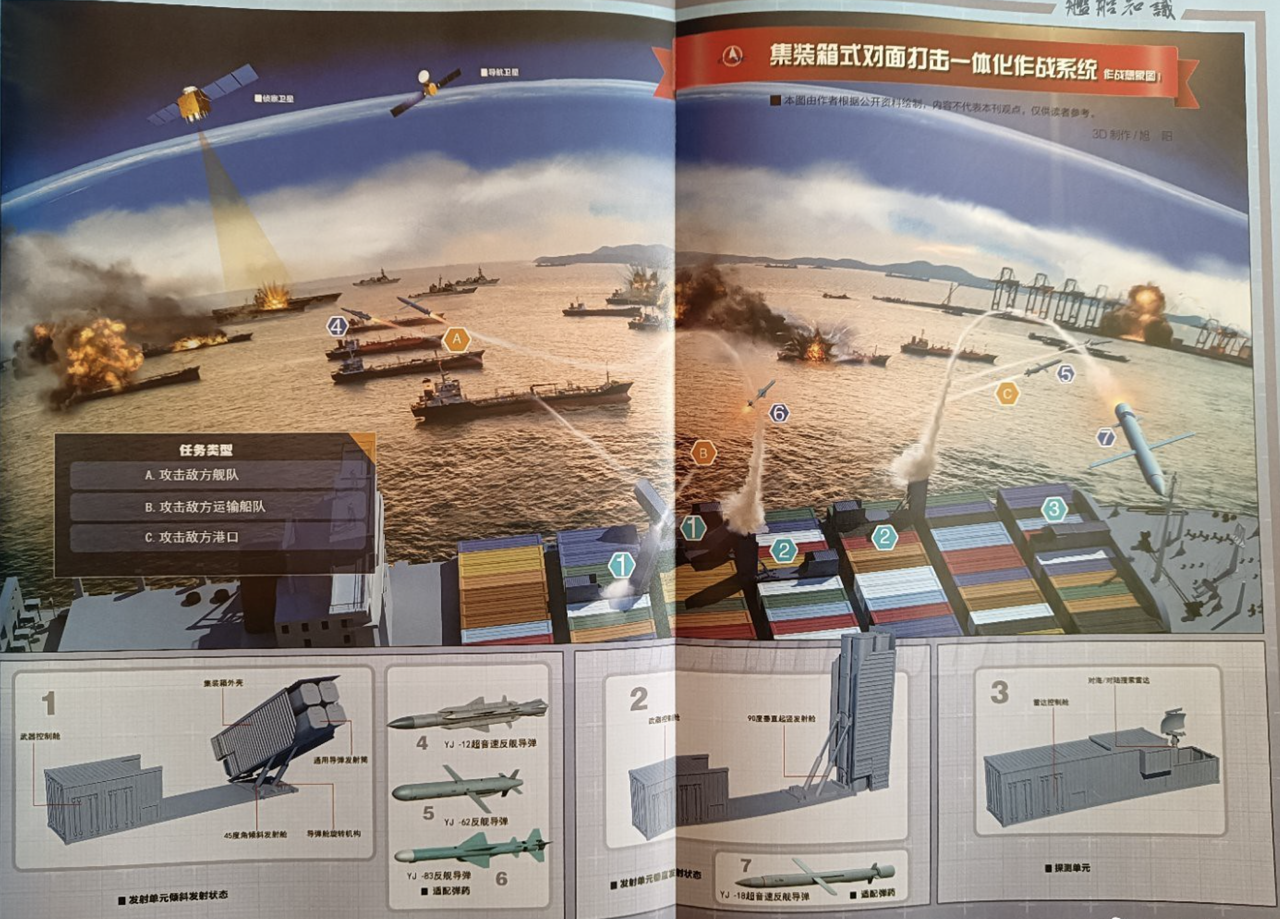
China claims that it has developed container-based missile launch systems, capable of concealing strike capabilities within ordinary commercial cargo. Unlike improvised systems used in active conflicts, these represent purpose-built weapons platforms designed for extended deployment. China's expanding control of critical port infrastructure in Latin America, the Caribbean, and worldwide creates favorable conditions for such systems to arrive undetected and deploy when needed.
This surveillance architecture extends beyond physical infrastructure through Nuctech, a Chinese state-linked firm supplying cargo scanners and transportation security equipment worldwide. These systems, designed to detect threats, serve as collection platforms for sensitive biometric, logistical, and trade data. The same adversary, and state-linked entities, that can smuggle container-based weapons systems also manufactures and maintains the scanners meant to detect illicit cargo.
A July 2020 Canadian government security review of Nuctech delivered damning findings. Canadian intelligence services determined that X-ray security scanners could potentially be used to “covertly collect and transmit information, compromise portable electronic devices as they pass through the scanner or alter results to allow transit of ‘nefarious’ devices.” That last capability is critical. Nuctech equipment can be programmed to clear weapons while displaying benign images to operators. A container-based missile system could appear as electronics or textiles because Beijing controls the output.
The U.S. banned Nuctech from airports in 2014 and from federal procurement in 2020. The EU launched an investigation in 2024. Yet, Nuctech scanners remain operational across Latin American ports, creating detection blind spots at the exact facilities where China has established operational control. Traditional port security assumes neutral detection systems. When the adversary supplies the scanners, that assumption becomes a critical vulnerability. Every Nuctech-equipped port represents a potential, pre-compromised, entry point where Chinese weapons shipments face no meaningful detection barrier.
China's port strategy achieves something more insidious than individual capabilities: systemic vertical integration. From port ownership to security systems, and from manifest control to inspection protocols, Beijing is acquiring key components of a supply chain that is able to covertly move weapons systems disguised as commercial cargo.
When a single strategic competitor controls all these elements, traditional port security becomes mere theater. A container holding drones or cruise missiles could be reported as identical to one carrying consumer electronics. The weapons can circumvent the barriers because China has now become the barrier.
Unlike concerns in the South China Sea, these threat vectors sit within immediate striking distance of the U.S. homeland. A container-based missile or drone system departing Manzanillo, Lázaro Cárdenas, or Kingston could reach targets across the southern United States. These ports provide launch positions and direct access to major transportation corridors that bypass traditional U.S. early warning systems oriented toward polar trajectories.
Houston's energy infrastructure, Phoenix's defense contractors, and San Diego's naval base all lie within the stated 540-kilometer range of Chinese container missiles if launched from Mexican ports. But the threat extends far beyond coastal launch points. These same containers can travel undetected along established trucking routes to the U.S. border – Ciudad Juárez alone sees nearly 3,000 commercial trucks daily. A containerized weapon system trucked from Manzanillo or Lázaro Cárdenas to the southern border could strike San Diego, El Paso, or Phoenix within minutes of activation.
This vertical integration model means China doesn't need to sneak weapons past U.S. defenses – they could be pre-positioned within our commercial lifelines and deployed to U.S. borders, cloaked by infrastructure and detection systems that Beijing supplies and controls.
Traditional understandings of border security assume adversaries must penetrate defenses from the outside. China's port infrastructure strategy inverts this model – the threat originates from within the commercial systems we depend upon. Responses to this threat vector must not simply focus on individual port acquisitions, but the systemic vulnerabilities created by vertical integration. This requires:
China's Latin American port expansion represents a different threat model than distant Indo-Pacific bases. This is infrastructure acquisition designed for immediate commercial and intelligence value, and feasibly for future operational use. The vertical integration from ports to security systems creates vulnerabilities that traditional security frameworks struggle to comprehensively address. Unlike in the 1962 Cuban Missile Crisis, container-based munitions can hide in plain sight within commercial infrastructure.
StelOptica Intelligence Insights provides strategic analysis at the intersection of open-source intelligence and emerging security challenges. Our analytical products leverage innovative analysis and collection methodologies to deliver actionable intelligence for decision-makers navigating complex security environments.