
04-03-2026 - StelOptica Intelligence Insights
The recent destruction and damage of two E-3G Sentry AWACS aircraft at Prince Sultan Air Base in Saudi Arabia — two of only 16 remaining AWACS aircraft in the entire U.S. fleet — alongside at least three KC-135 Stratotanker refueling aircraft, represents more than just a tactical loss. It is an indictment of force protection doctrine that failed to absorb lessons already written in Ukrainian blood.
One month into the conflict, satellite imagery confirmed the U.S. was still parking valuable assets clustered in the open, well within Iranian drone and missile range — an exposure that becomes all the more important given documented Russia-Iran and China-Iran intelligence sharing. Former U.S. military officials have assessed that Russia most likely provided Iran with geographic coordinates and satellite imagery enabling the precise targeting of the E-3Gs. The adversary didn't need air superiority, they just needed to know where to look.
Tehran's targeting logic has been deliberate from the outset. Rather than contesting U.S. air superiority directly — a fight it cannot win — Iran has methodically pursued the infrastructure that makes American airpower function: the radars that detect threats, the tankers that extend range, and the AWACS that directs the battle. This is a counter-air campaign adapted to asymmetric realities, and the damage is real.
The E-3 fleet entered service in the late 1970s. It has shrunk from 32 aircraft in 2015 to 16 today, with a mission-capable rate hovering around 56 percent. With one now destroyed and another damaged, that number drops to 14 operationally viable platforms. Iran didn't just destroy a $500 million aircraft — it removed one of the battlespace's central nervous systems. One AWACS doesn't equal one aircraft. It supports dozens of simultaneous fighters, intercepts, and coordinated missions, and losing even one compresses early warning timelines and degrades the coordination capacity the entire theater depends on.
The tanker losses compound this in a different but equally serious way. The KC-135 fleet is aging, maintenance demands are accelerating, and the KC-46 replacement program has faced persistent issues that leave the Air Force chronically short. As of April 3rd 2026, 8 KC-135s have been lost (2 destroyed, 6 damaged). Iranian strikes have already forced sortie generation further from the fight — increasing tanker demand at exactly the moment tanker availability is declining.

Before the AWACS and tanker losses, the cost of inadequate force protection was already being paid in American lives. Six U.S. service members were killed at a tactical operations center in Kuwait that had virtually no protection from overhead drone attack. No netting. No hardened roof. No meaningful passive defense against low, slow, inexpensive drones — the exact threat profile Ukraine has been managing for years.
This should not have been a surprise. It is not novel technology. It was a Shahed-class one-way attack drone, the same system Russia has been deploying against Ukrainian cities and critical infrastructure since 2022. The U.S. had ample evidence, ample time, and ample analytical output warning of exactly this threat. Despite conferences, workshops, and working groups focused on the problem, that awareness never translated into action at the installation level. We are now having to execute force protection upgrades in a combat zone that should have been implemented before the first airstrike occurred.
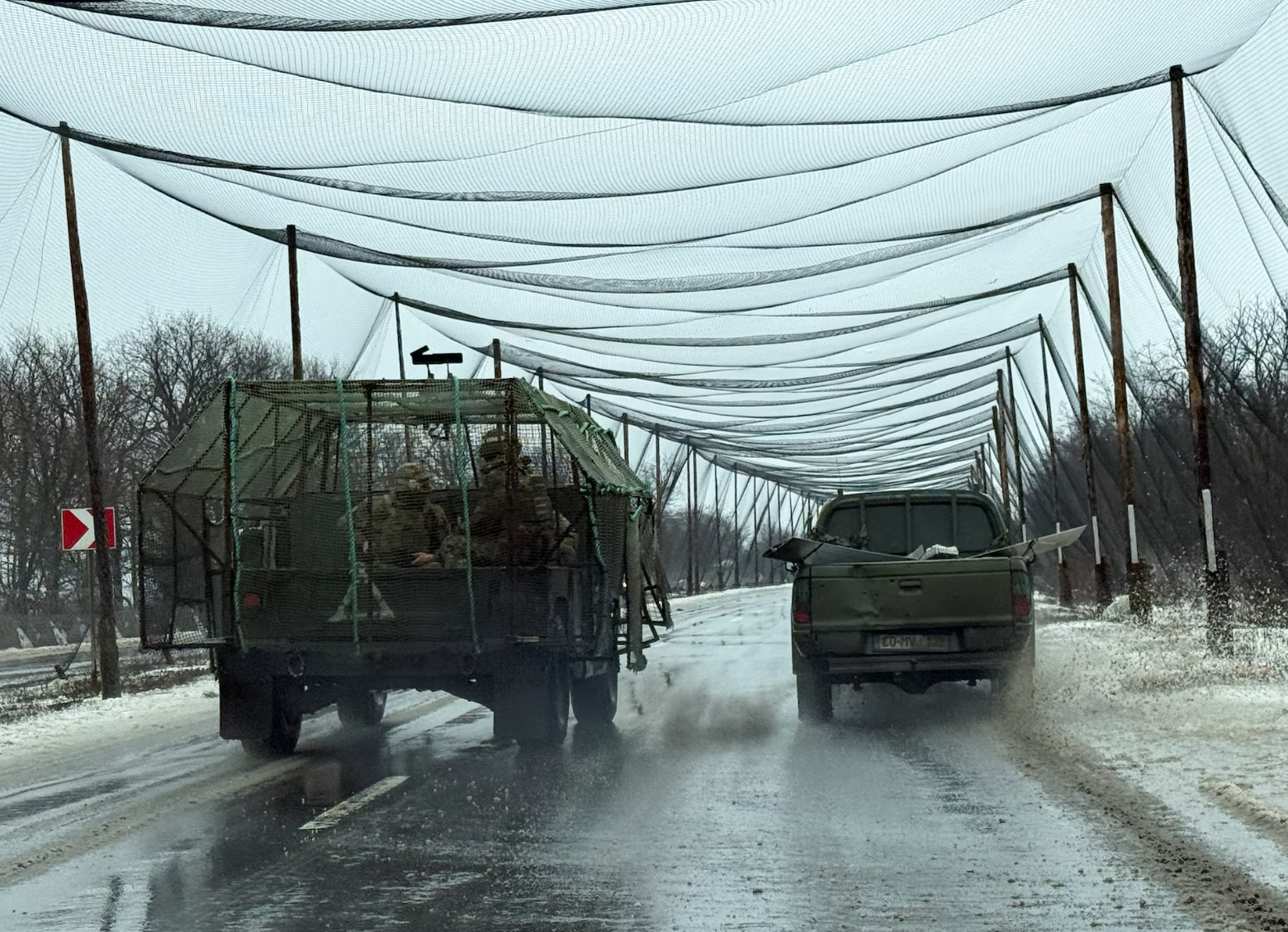
Ukraine and Russia solved this. Tanks received cage armor. Supply routes near the front were strung with netting to catch drones before they reached their targets. Both sides developed fiber-optic-guided systems to defeat jamming. Physical passive defense — low-cost, low-tech, immediately deployable — became baseline practice in any contested environment.
The U.S. watched all of this and largely kicked the bucket down the road. For years, military officials pushed back on the cost-effectiveness of physically hardening bases and sheltering aircraft. The Joint Inter-Agency Task Force 401 released new guidance recommending overhead netting, tensioned cables, and structural shielding in January 2026. The framework is called HOP: Harden, Obscure, Perimeter. It is the right framework. It is also arriving to U.S. doctrine approximately four years late.
China, meanwhile, has been on an extensive program of hardening shelters at air bases across the country. This is likely not coincidental. As explored in SII 01: Operational Transparency vs. Strategic Ambiguity, every operational employment of advanced U.S. munitions — including deep-penetration bunker busters — provides adversaries with a measurable benchmark for exactly how deep and how strong their next generation of infrastructure needs to be. China is not just hardening in the abstract. It is hardening against a specific, observed, and now well-characterized U.S. capability ceiling.
William Spaniel's analysis of Trojan Horse drone tactics, and the broader literature on how low-cost unmanned systems are reshaping modern conflict, described this problem before it arrived in the Gulf. The Iran conflict is the operationalized version of that thesis.
In 2026, the U.S. spent billions in interceptor munitions shooting down cheap UAVs launched by a sanctions-constrained adversary. China is targeting a production capacity of one million tactical UAS by 2026. The U.S. procured 50,000 in 2025. The manufacturing gap is not a future problem — it is a current one. And the cost exchange on base defense is worse still: a $20,000 Shahed can destroy a $500 million AWACS if no net is strung overhead and no shelter is built around it. That is not a technology failure. That is a prioritization failure.
The primary lesson of the Ukraine war was that the world has entered an era of precise mass — low-cost, scalable, accurate systems that can be fielded by states and non-state actors alike. Systems comparable to the Shahed can be scaled in months given proper investment. The U.S. has the industrial capacity. What has been missing is urgency.
The loss of the E-3Gs and the sustained attrition of the tanker fleet are not isolated incidents. They are the compounding product of a doctrine that treated drone threats as manageable background noise while Iran and its network of proxies treated them as a primary instrument of coercion. The result is a technologically superior force absorbing meaningful degradation from a technologically inferior one — because the superior force left its most valuable assets in the open.
The FPV penetration of Victory Base by Kataib Hezbollah introduces a further complication. Small, agile, manually piloted drones with minimal radar cross-section are now being employed against installations whose counter-UAS architecture was built for larger, slower, GNSS-guided threats. The threat is evolving faster than the procurement cycle. That gap will not close on its own.
Replacement of the destroyed E-3G is not feasible before the 2030s. The fleet was already thin. Every day that high-value aircraft, personnel facilities, and command infrastructure remain unshielded in-theater is another day Iran's targeting calculus favors continued engagement. The window for remediation is open — but it will not stay that way indefinitely. Unlike infrastructure or industrial capacity, tactical opportunity is perishable.
StelOptica Intelligence Insights provides strategic analysis at the intersection of open-source intelligence and emerging security challenges. Our analytical products leverage innovative analysis and collection methodologies to deliver actionable intelligence for decision-makers navigating complex security environments.